Every June, the same pattern plays out in dental offices near the coast: patients who have been meaning to address their smile come in asking about whitening before the summer social calendar kicks into full gear. Beach days, outdoor events, family gatherings, and weddings fill the next three months, and there is something about that visibility — the candid photos, the sunlit conversations — that finally moves the whitening question from the back of the mind to an actual appointment.
At Polished Smiles in Torrance, we have that conversation regularly, and the same questions come up almost every time. What actually works? Why didn’t the strips do much? Will my teeth hurt? Is there a difference between whitening options? The honest answers are more useful than most of what patients find when they search on their own — so here is what we actually tell people.
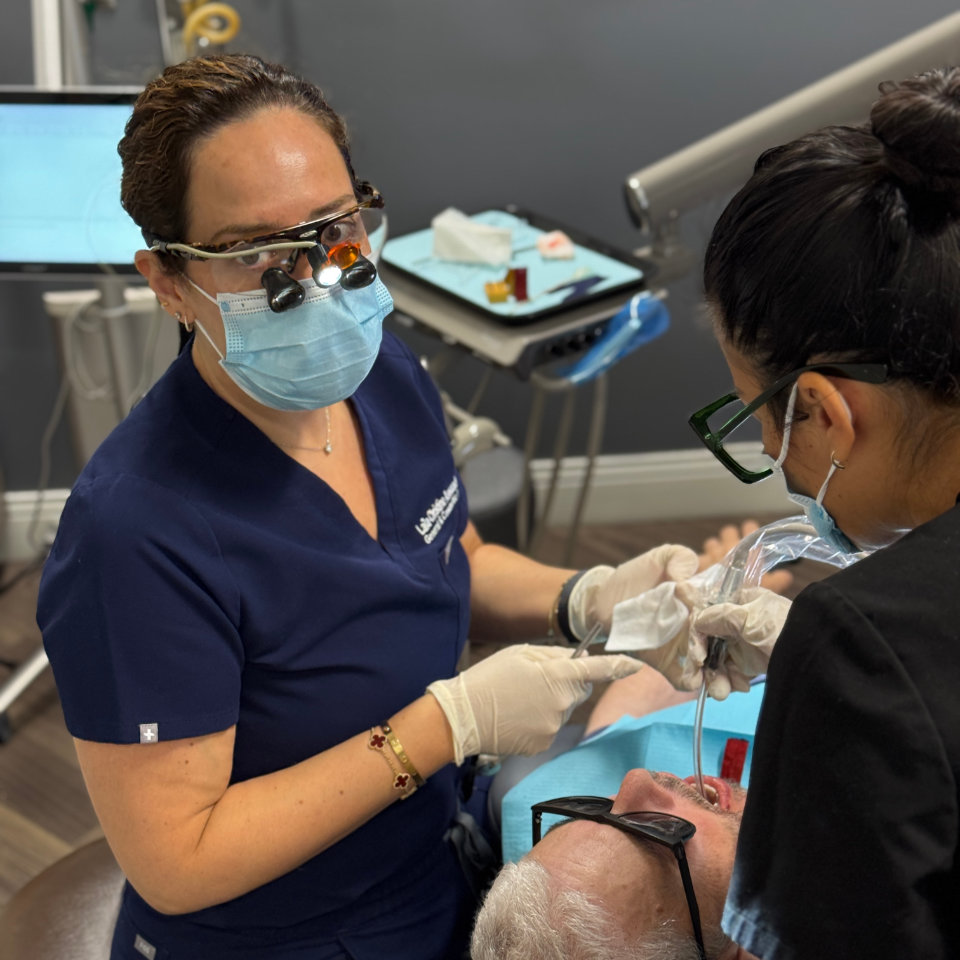
Dr. Laila Assaad earned her Doctor of Dental Medicine from the University of Montreal and completed her advanced residency at New York Presbyterian Hospital of Columbia and Cornell University, where her training included the full spectrum of restorative and cosmetic dental care. With more than 15 years of clinical experience, she approaches whitening as a clinical service — which means evaluating each patient’s specific situation before making a recommendation, rather than offering the same protocol to everyone.
Why Teeth Yellow — and Why It Matters for Treatment
Tooth discoloration falls into two categories, and understanding which one applies determines what treatment will actually work.
Extrinsic staining sits on or near the surface of the enamel, deposited by the usual suspects — coffee, tea, red wine, dark foods, and tobacco. This type of staining responds well to professional bleaching agents, and it is also addressed by the professional cleaning that precedes any whitening treatment. Removing the calculus and surface deposits first means the bleaching agent contacts actual enamel rather than a layer of accumulated stain, which makes a meaningful difference in the outcome.
Intrinsic discoloration originates within the tooth structure itself — in the dentin, the layer beneath the enamel. This is the yellowing that accumulates with age as enamel naturally thins and dentin darkens from within. Certain antibiotics taken during childhood, particularly tetracyclines, cause intrinsic staining that is embedded in the tooth’s structure. Fluorosis produces white or brown spots within the enamel.
Whitening agents can improve moderate intrinsic discoloration, particularly age-related yellowing. Severe intrinsic staining — deep tetracycline banding, for instance — may require veneers rather than bleaching to achieve the outcome the patient is hoping for. Knowing which category applies before starting treatment is what separates a satisfying whitening result from an expensive disappointment.
Professional vs. Over-the-Counter: The Actual Difference
Over-the-counter whitening products work for some patients to some degree, and the patients who are satisfied with them often don’t come in asking questions. The patients who come in are typically those for whom strips or trays produced minimal change — and the explanation is usually concentration.
FDA over-the-counter regulations limit the hydrogen peroxide concentration in consumer whitening products to approximately 6 to 10 percent — a level considered safe for unsupervised use. Professional whitening systems prescribed or administered by a dentist use concentrations of 15 to 38 percent, applied under clinical guidance. The oxidation chemistry that breaks down the chromogenic compounds responsible for tooth color is more complete at higher concentrations, and the difference in outcome is often dramatic rather than incremental — particularly for patients with moderate to significant discoloration.
Custom-fitted whitening trays, fabricated from impressions of the patient’s own teeth, also outperform generic strip delivery for a specific reason: consistent contact. A strip designed for a generic dental arch sits well against some teeth and poorly against others, producing uneven contact between the bleaching gel and the enamel that results in inconsistent whitening across the smile. A custom tray fits precisely against every tooth surface, maintaining even gel contact throughout the treatment period. The trays are also reusable — patients can use them for periodic touch-up treatments with professional-strength gel for years after their initial whitening.
What to Expect from the Process
For patients choosing take-home professional whitening, the process begins with an impression or digital scan to fabricate the custom trays, which are typically ready within a few days. The treatment course — wearing the trays with professional-strength gel for a prescribed period daily — typically spans one to two weeks, depending on the starting shade and the target result. Dr. Assaad recommends the appropriate gel concentration and treatment duration based on each patient’s enamel sensitivity and whitening goals.
In-office whitening — where a higher-concentration gel is applied by the clinical team during a chairside appointment — produces results in a single visit and is the faster option for patients whose timing is driven by an upcoming event. It is often followed by a take-home maintenance kit to extend and preserve the result.
Sensitivity during and after whitening is the most commonly reported side effect, and it is temporary. It typically resolves within 24 to 48 hours of completing treatment. Patients with pre-existing sensitivity may benefit from using a desensitizing toothpaste in the weeks before beginning treatment, which Dr. Assaad can recommend based on the clinical exam.
Whitening and Existing Restorations
One conversation worth having before whitening begins: if you have crowns, veneers, or composite bonding on your front teeth, those restorations will not change color with bleaching. Dental ceramic and composite materials do not respond to the oxidation chemistry that affects natural enamel. Whitening the surrounding natural teeth can create a visible mismatch between the lightened enamel and the unchanged restorations.
This is not a reason to avoid whitening — it is a reason to discuss existing restorations with Dr. Assaad before starting, so the plan accounts for them. In some cases, whitening first and then updating the restorations to match the new shade is the right sequence. In others, the existing restorations set the color target. The consultation is where that determination is made.
Schedule Before Summer Fills Up
We invite you to call us at (310) 373-0667 to schedule a whitening consultation. June appointments fill quickly as the season picks up, and a consultation is a brief, no-commitment conversation about what whitening can realistically do for your specific situation.
Our Torrance office serves patients from across the South Bay — Redondo Beach, Palos Verdes, Manhattan Beach, and the surrounding communities. Summer is short and the calendar fills fast. Let us help you start it with a smile you feel good about.
Medically reviewed by Laila-Christine Assaad, D.M.D. on
Posted on behalf of
23451 Madison Street Suite 120
Torrance, CA 90505
Phone: 424-401-9424
Email: [email protected]
Opening Hours
Monday - Friday
7:30 am - 3:30 pm